Artificial Intelligence Intern
TEACHNOOK (TEACHSCAPE ONLINE LEARNING SERVICES PRIVATE LIMITED) | Sep 2024 - Nov 2024
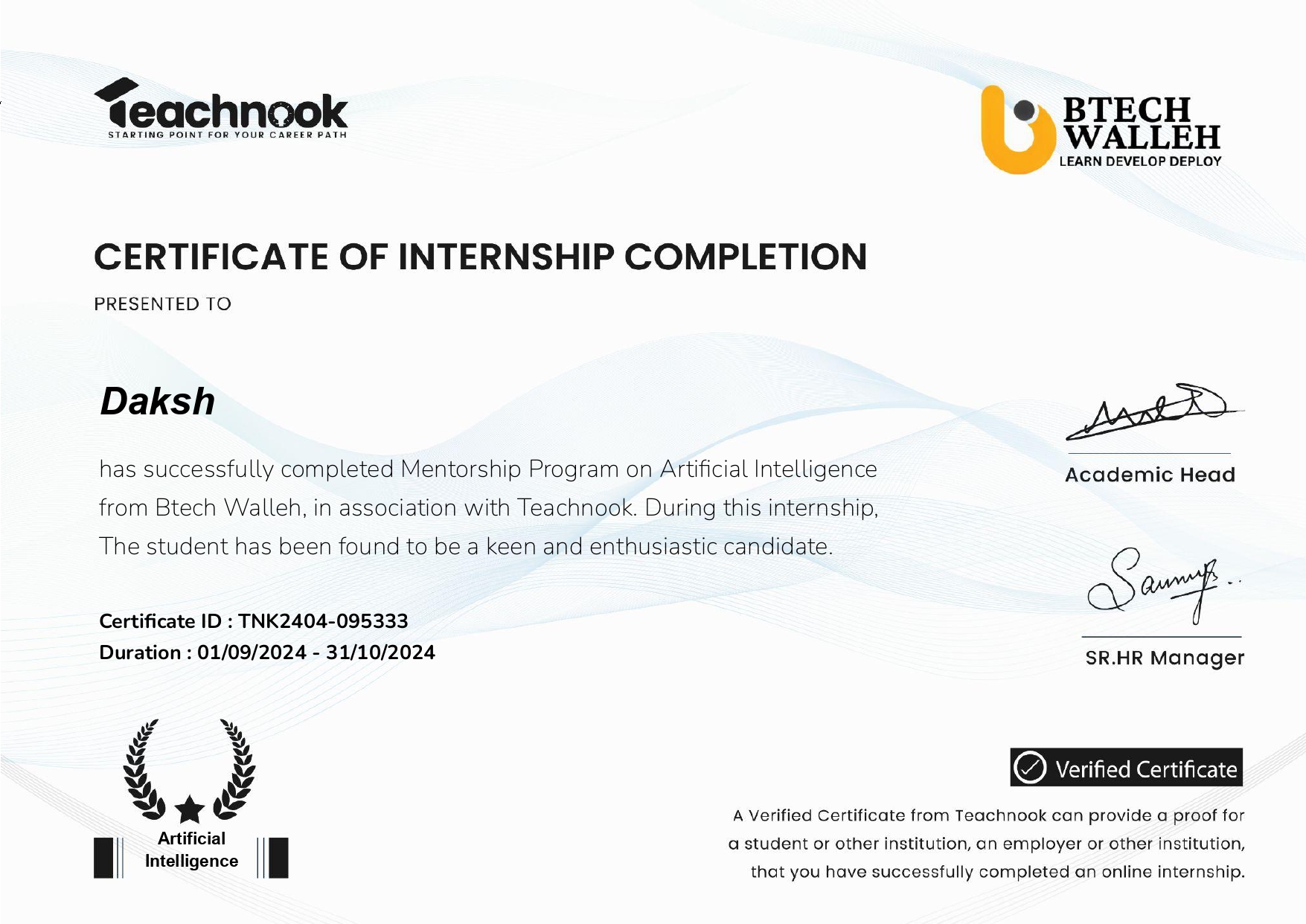
Teachnook AI Internship
During my two-month internship at Teachnook, an innovative edtech company focused on Artificial Intelligence (AI), I engaged in an intensive and structured mentorship program designed to bridge the gap between theoretical learning and practical application. The primary objective of the internship was to immerse myself in real-world AI concepts, build functional AI models, and apply them to educational contexts through hands-on projects and collaborative learning.
The internship journey began with foundational concepts in AI and machine learning, gradually progressing into advanced topics such as deep learning, natural language processing (NLP), reinforcement learning, generative adversarial networks (GANs), computer vision, cloud deployment, and explainable AI. Each week was designed to build upon the last, with theory being immediately reinforced through coding exercises, model building, and collaborative projects.
One of the highlights of the internship was the major project—developing a movie recommendation system. This capstone project integrated multiple AI techniques such as collaborative filtering, user data analysis, and performance evaluation. By working on this system, I applied machine learning algorithms to real-world user behavior, building a tool that could personalize content suggestions for users. In addition to this, I also worked on smaller “micro projects,” including a sentiment analysis tool to assess user feedback, a chatbot using NLP, and a data visualization dashboard to track user engagement.
Each week of the program focused on a new topic. For instance, the first week covered setting up development environments and understanding machine learning types, while the second week delved into neural networks and CNNs for image classification. By the third week, I was building sentiment analysis tools using NLP libraries like NLTK and TextBlob and implementing basic reinforcement learning agents. The progression continued with exposure to GANs, transfer learning with pre-trained models, cloud deployment strategies, and computer vision using frameworks like YOLO and OpenCV.
In the sixth and seventh weeks, the focus shifted toward speech recognition, time series forecasting, AI ethics, and explainable AI. These topics allowed me to explore practical use-cases beyond standard classification or regression problems and emphasized the societal and ethical implications of deploying AI solutions—especially in education.
A major outcome of this internship was the development of both technical and soft skills. On the technical side, I gained fluency in Python programming, data preprocessing, model optimization, and cloud deployment. Tools and frameworks like TensorFlow, Keras, Scikit-learn, and Pandas became integral to my workflow. On the soft skills front, I improved my communication abilities, particularly in explaining technical concepts to non-technical peers, and honed my teamwork and time management skills through collaborative tasks and regular team meetings.
There were challenges as well. Adapting to the fast pace of technological change required constant learning. Moreover, incorporating user feedback into development highlighted the need for balancing technical feasibility with user expectations. Nonetheless, through proactive problem-solving, continuous self-study, and open communication with mentors, I was able to overcome these hurdles effectively.
The academic concepts I studied—such as supervised and unsupervised learning, decision trees, clustering, and NLP—were directly applicable throughout the internship. This real-world application significantly deepened my understanding of these theories and demonstrated their relevance in practical AI systems. For example, knowledge of collaborative filtering from my coursework played a vital role in shaping the recommendation engine.
Supervisor feedback emphasized my strengths in technical reliability, coding proficiency, and collaboration, while also identifying areas for growth—specifically, improving time management and public speaking. I have taken these insights to heart and am already working on refining those skills for future professional roles.
In conclusion, this internship at Teachnook was a transformative experience that solidified my passion for AI, particularly in the field of educational technology. It not only helped me develop a strong foundation in modern AI tools and frameworks but also gave me confidence in applying this knowledge to solve real-world problems. Moving forward, I am motivated to further my education in AI and data science, with the goal of contributing meaningfully to the development of intelligent, user-centric educational platforms.